What Is a Managed Operations Service?
If you've ever hired a virtual assistant - through an agency, a freelance platform, or a referral - you already know how the story usually goes.
The first few weeks are promising. Then training takes longer than expected. Then the quality is inconsistent. Then they're sick for two weeks and nothing gets done. Then they leave, and you're back to doing everything yourself while also recruiting again.
It's a cycle that plays out in thousands of businesses every year. And the frustrating part is that the underlying need - operational support so you can focus on growth - is completely valid. The model for meeting that need is just broken.
A managed operations service is a different model entirely. Here's what it means and why it works better.
The Traditional VA Model: What You Actually Get
When you hire through a traditional VA agency, here's what typically happens:
The agency places a person with you based on your brief.
You are responsible for training them on your systems, processes, and standards.
You are responsible for managing their workload, quality, and performance.
If they're sick, on leave, or quit - your operational support stops completely.
If the quality isn't right, you manage the performance conversation.
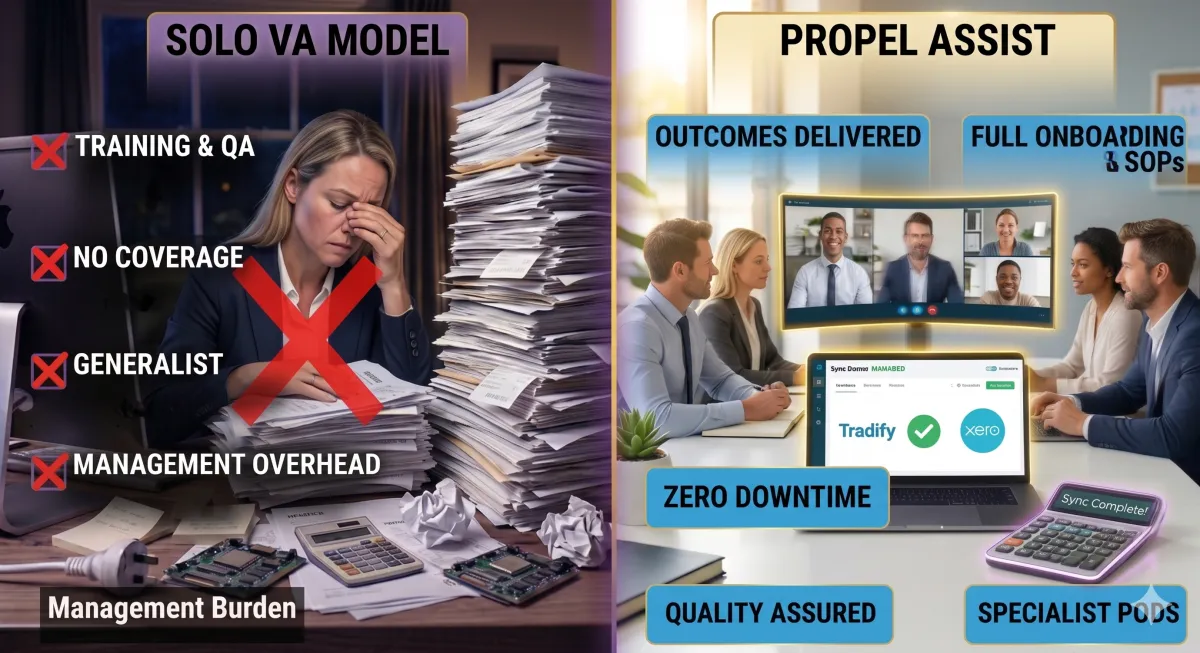
In other words: you've outsourced the hiring process but not the management overhead. You still have a person to train, manage, quality-check, and cover when they're unavailable. For many business owners, the burden of managing a VA is nearly as significant as the burden of doing the work themselves.
This is why so many businesses try the VA model, have a disappointing experience, and go back to doing everything themselves.
The Managed Operations Model: What's Different
A managed operations service shifts the responsibility fundamentally. Instead of placing a person with you, it delivers outcomes.
Here's what the model looks like in practice:
We Handle Onboarding and Training
When you engage Propel Assist, our internal team handles the onboarding and training process. Your role is to brief us on your requirements and standards. We document the process, build the SOPs, and train our team. You don't spend your time teaching someone your systems - we learn them ourselves and build the process around your business.
We Handle Quality Assurance
Every deliverable that comes from a Propel Assist team goes through internal quality checks before it reaches you. Your inbox responses, your CRM updates, your scheduled posts - all reviewed before they're sent. You're not the quality check. We are.
Zero Downtime Coverage
In a traditional VA model, if your person is sick, the work stops. In a managed service model, we maintain an internal resource pool. If one team member is unavailable, coverage is assigned without interruption to your operations. You don't manage this - it's built into the model.
Specialist Pods, Not Generalists
Traditional VA models typically use generalists - one person expected to handle everything from CRM entry to social media to accounts coordination. The managed service model routes tasks to the specialist best suited for them. Admin tasks go to an admin specialist. Social media goes to someone with social media expertise. The quality of output improves significantly.
Flexible Engagement
Propel Assist operates on short-term flexible agreements - minimum 6 weeks - rather than long-term lock-ins. As your needs change, your level of support can scale up or down without complicated renegotiations.
The Cost Comparison
Let's be direct about the numbers:
Full-time in-house employee (admin/ops): $55,000-$75,000/year plus super, equipment, training, and HR overhead. True total cost: $70,000-$100,000+/year.
Traditional VA agency (40 hours/week): $20-$30/hour plus agency margin. True total cost: $40,000-$60,000/year - plus your management time.
Propel Assist (managed service): From $15/hour equivalent for specialist-delivered, quality-assured outcomes. Flexible hours. No management overhead. No downtime risk.
For most businesses, Propel Assist costs less than 25% of what an equivalent in-house hire would cost - with significantly lower management burden and zero downtime risk.
Who Is the Managed Operations Model Right For?
Propel Assist works best for:
Trades and service businesses doing $300k-$5M in revenue
Business owners who are currently doing significant amounts of their own admin
Businesses that have tried a VA, been disappointed, and written off the model
Growing businesses that need flexible support that scales without the overhead of a full hire
Business owners who want outcomes, not a management overhead
👉 Book a free discovery call at helpmepropel.com.au - let's design a support model that delivers outcomes for your business without adding management overhead.