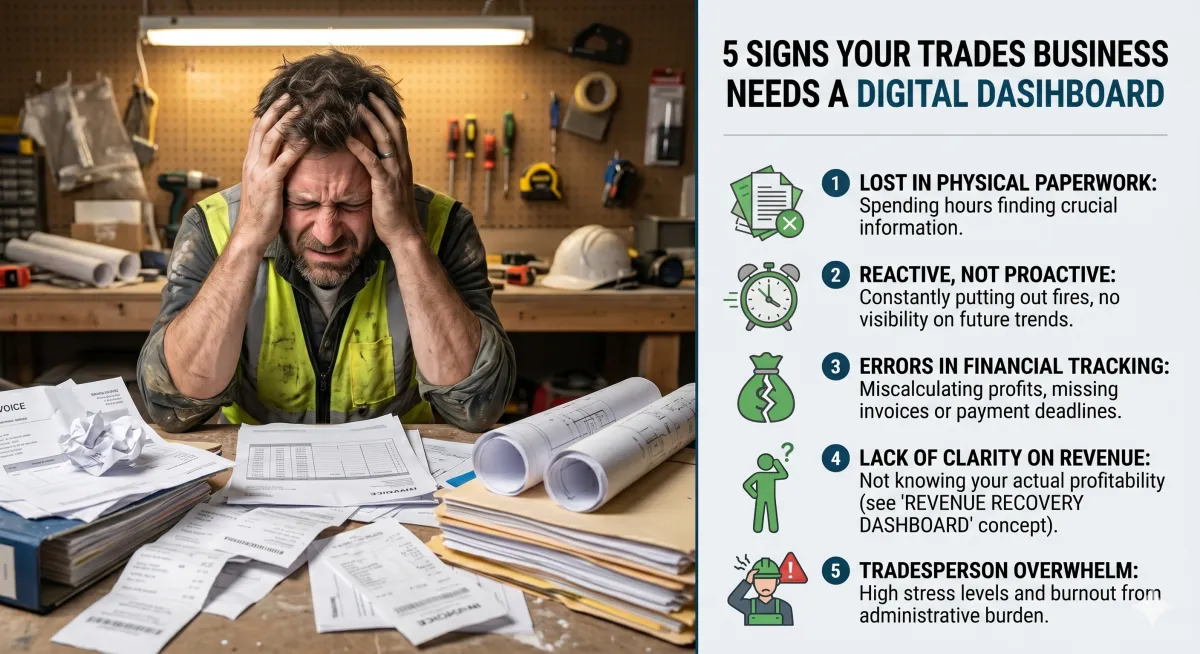
5 Signs Your Trades Business Has Outgrown Its Current System — And What to Do Next
Growing a trades business is something to be proud of. More jobs, more staff, more revenue. But growth comes with a hidden tax — and it's one that catches most business owners off-guard.
The systems that got you to where you are today are often the same systems holding you back from where you want to go. Spreadsheets, basic apps, and manual processes work fine when you're small. But past a certain point, they start costing you more than they save.
Here are the five clearest signs your trades business has outgrown its current system - and what to do about each one.
Sign 1: You're Spending More Than 5 Hours a Week on Admin
For a solo operator or a business with 2-3 staff, 5 hours of admin per week is manageable. For a business doing $500k+ in revenue with a team of 5 or more, 5 hours of admin per week means your systems are working against you.
The most common admin time wasters we see in trades businesses at this stage are:
Re-entering job data from one system into another
Manually chasing overdue invoices that should be automated
Creating quotes from scratch because there are no templates
Answering 'where is the job at?' messages from clients because there's no real-time visibility
If admin is consistently eating more than 5 hours of your week, you're not just losing time - you're losing the mental energy that should be going into growing the business.
Sign 2: You've Missed Revenue on Jobs You've Already Done
This one is harder to spot because the revenue you've missed is invisible. You don't get a report showing you what you forgot to invoice. You only find out if you have the time and systems to audit your jobs — which most businesses don't.
The most common causes of invisible revenue loss in trades businesses are:
Variations that were done verbally and never formally logged or invoiced
Materials costs that weren't tracked against the job and were absorbed as overhead
Jobs that were completed but invoiced at the original quote price despite scope changes
If any of these sound familiar, your current system isn't giving you the tools to protect your revenue. A proper job management platform like Simpro or Tradify has formal variation approval, live job costing, and materials tracking built in.
Sign 3: You Can't Tell Me Your Current Profit Margin Without Waiting Until Month End
This is a big one. If you have to wait until your bookkeeper sends you the monthly P&L to know whether your business is profitable — your systems have a serious visibility problem.
In a well-configured job management system connected to Xero, you should be able to tell me right now:
The current margin on every active job
Total outstanding invoiced amount
How many jobs are currently over-budget vs under-budget
Your busiest and most profitable service line this month
If none of those are answerable in under 60 seconds, your systems aren't working hard enough for you.
Sign 4: Your Team Is Using Multiple Apps to Manage a Single Job
You quote in a spreadsheet. You schedule in a calendar. You communicate job updates in WhatsApp. You invoice in Xero. You file documents in email. And somewhere in the middle, things get lost.
This fragmented workflow is one of the most common productivity killers we see in growing trades businesses. When a single job lives across 5 different apps, the risk of something falling through the cracks is extremely high. And the time spent switching between systems adds up fast.
When you're at the point where each job requires coordination across more than 2-3 tools, it's time to consolidate into a single job management platform that handles everything from quote to payment.
Sign 5: You've Had to Rebuild From Scratch After Losing a Team Member
One of the most painful growth stages for a trades business is when a key person leaves - and takes all their knowledge with them. If your systems live in someone's head, in their personal phone, or in files only they know how to find, you don't have business systems. You have people dependencies.
A properly set up job management platform means:
All job information is in the system, not in someone's head
New team members can be onboarded to a documented, consistent process
When someone leaves, the business continues without disruption
If losing one team member has ever put you in a position where you had to rebuild processes from scratch, that's a system problem — not a people problem.
What to Do Next
If two or more of these signs apply to your business, the good news is that none of them are permanent. They're all symptoms of the same underlying issue: systems that haven't kept pace with your growth.
The right job management platform - implemented correctly - fixes all five of these problems simultaneously. The key word is correctly. We've seen businesses move to Simpro or Tradify and still have all five problems three months later because the implementation was rushed or incomplete.
At Propel Tech, we implement Simpro and Tradify end-to-end - including data migration, Xero integration, team training, and a clean handover — so you actually get the results the platform is capable of.
Book a free Tech Audit at helpmepropel.com.au — we'll identify exactly which signs apply to your business and recommend the right platform for your stage.