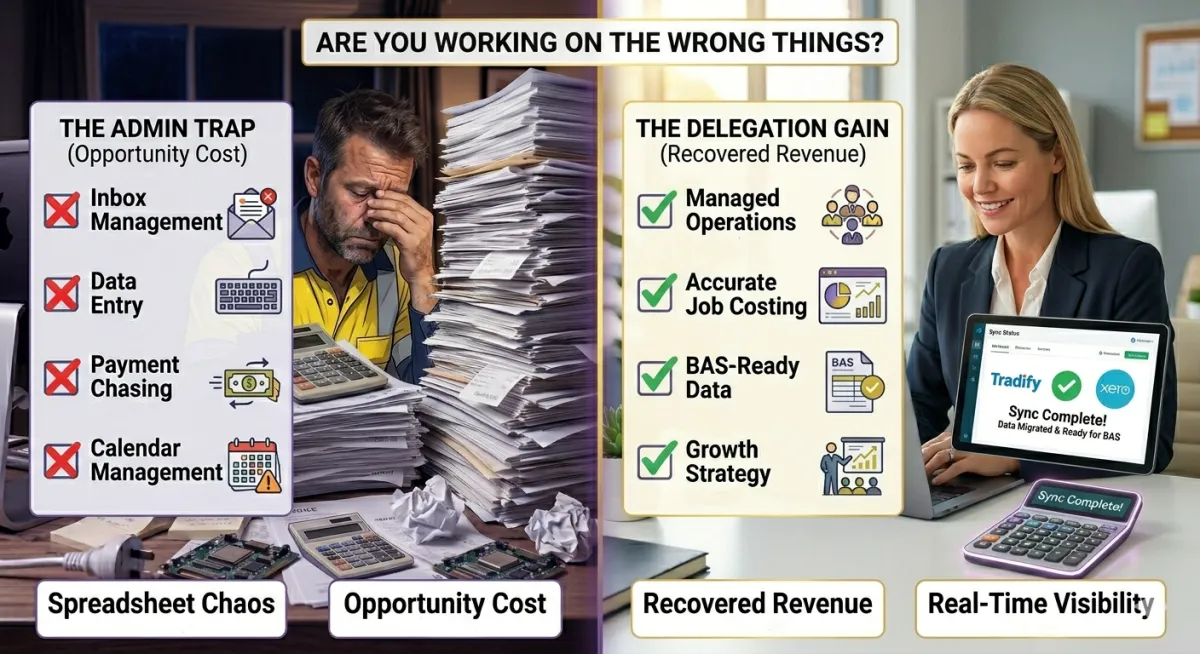
5 Tasks Every Business Owner Should Stop Doing This Week
There's a version of you that spends most of your working week on high-value, revenue-generating work. Strategy, relationships, sales, product development, growth planning. The work that only you can do. The work that actually moves the needle.
And then there's the version most business owners actually live - where the day starts with intent and gets consumed by email, admin, follow-ups, scheduling, and the endless stream of operational tasks that somehow always feel urgent.
The gap between those two versions isn't a motivation problem. It's a delegation problem. And it starts with identifying the specific tasks that should come off your plate first.
Here are the five tasks we see business owners holding onto that they should stop doing this week.
Task 1: Inbox Management
The average business owner spends 2-3 hours per day in their inbox. That's 10-15 hours per week. Most of those emails don't require you - they require a response that follows a pattern you could document in 30 minutes.
What inbox management looks like when delegated correctly:
Incoming emails are triaged by priority - urgent (needs you), standard (has a template response), admin (can be handled without you)
Standard emails are responded to by your support person using approved templates
Admin emails (invoices, confirmations, scheduling) are handled completely
You receive a daily digest of the emails that actually need your input
Who should do it: A trained operations support person who understands your business, your clients, and your communication style. This is core Propel Assist work.
Task 2: Invoice Follow-Ups and Payment Chasing
Chasing money you've already earned is one of the most demoralising tasks in running a business. It's also one of the easiest to delegate.
A good payment follow-up system is systematic and consistent: first reminder at 7 days overdue, second at 14 days, escalation at 21 days. This doesn't require your personal involvement - it requires a documented process and someone to execute it.
Most businesses that delegate invoice follow-ups see their average debtor days drop by 30-50% within the first month - not because the process changed, but because it actually happens consistently instead of whenever the owner gets around to it.
Who should do it: An operations support person with access to your invoicing system. Alternatively, set up automated reminders in Tradify or Simpro - this is part of what Propel Tech configures during implementation.
Task 3: Scheduling and Calendar Management
Managing your own calendar seems like a small thing. It's not. Between the back-and-forth of finding a meeting time, rescheduling conflicts, setting reminders, and coordinating across multiple people - calendar management easily consumes 3-5 hours per week for an active business owner.
Delegated calendar management means:
Meeting requests are handled and responded to without involving you until the meeting is confirmed
Your week is blocked with protected time for deep work, client meetings, and team time
Conflicts are resolved before they become problems
Reminders and briefing notes are prepared before important meetings
Who should do it: An operations support person with access to your calendar and a clear understanding of your priorities.
Task 4: CRM Data Entry and Status Updates
CRM hygiene is critical - but maintaining it is one of the most time-consuming administrative tasks in a growing business. Leads to be logged, job statuses to update, follow-up dates to set, client notes to record. When a business owner is managing all of this themselves, it rarely stays current - and a CRM that isn't current is worse than no CRM at all.
Delegated CRM management means:
All new leads are logged and tagged correctly within 24 hours
Job and deal statuses are updated after every interaction
Follow-up tasks are created and assigned so nothing falls through
Regular CRM audits to catch duplicates, missing data, and stale records
Who should do it: An operations support person with CRM training. Propel Assist teams are already familiar with GoHighLevel, Simpro, Tradify, and other common platforms.
Task 5: Social Media Posting and Content Scheduling
This one surprises some business owners because they feel social media is 'their voice' and needs to come from them personally. It does - but the ideas, direction, and key messages should come from you, while the execution (scheduling, formatting, posting, and basic engagement) is entirely delegatable.
A good content workflow looks like this:
• You (or your marketing team) prepare the content - captions, hooks, key messages
• Your support person formats, schedules, and posts across all platforms
• Basic engagement (responding to comments, liking interactions) is handled by support
• You're notified of comments or DMs that require your personal response
Who should do it: An operations support person with social media platform training. Propel Assist handles social media posting and scheduling as a standard service.
The Common Thread
All five of these tasks share one characteristic: they don't require you. They require a systematic, reliable, trained person or process. And they're collectively consuming 15-25 hours of most business owners' weeks.
That's 15-25 hours per week that could be going to sales. To strategy. To the relationships that grow your business. To actually taking a proper break so you're sharper for the work that does require you.
👉 Book a free discovery call at helpmepropel.com.au - tell us the three tasks that keep landing back on your desk, and we'll map out how to get them off your plate for good.